PeptideOS: a peptide reference that shows its sources
PeptideOS is a product we built and run. It is a pharmacokinetics reference with one rule: every figure carries its source or is marked unknown.
Launched
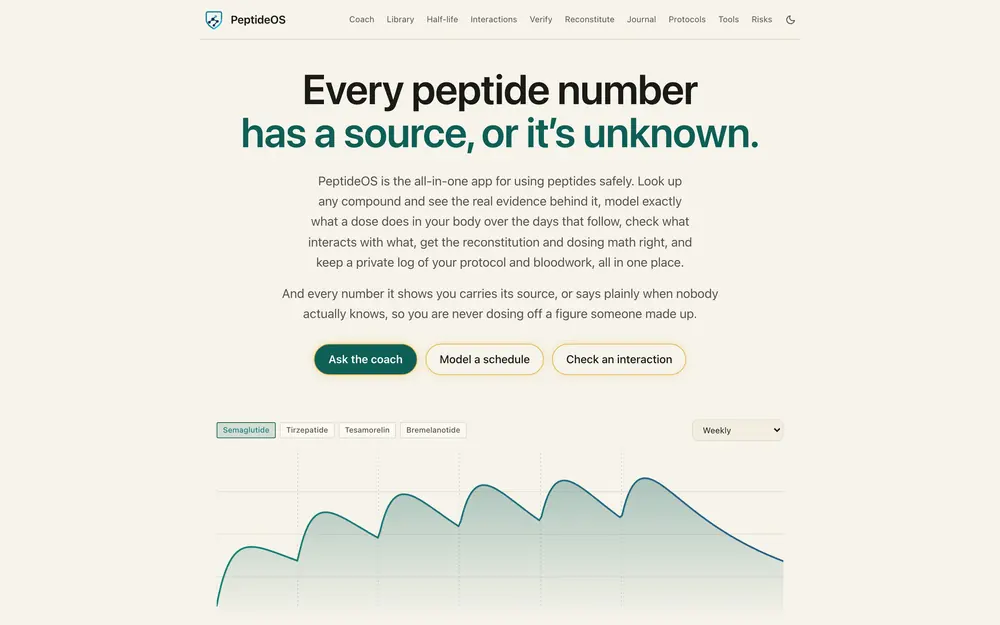
PeptideOS home page, Product, Research reference
The business
PeptideOS is our own subscription reference for people researching peptides. It covers half-lives, reconstitution, interactions and dosing schedules, and it runs in the browser as an installable web app at peptideos.dev.
The problem
Most peptide dosing figures online have no human study behind them. They trace back to forums and vendor pages, then get repeated until they look like settled fact. A reference that copies those numbers inherits the guesswork, so we built one that refuses to show a figure it cannot cite.
What we built
The parts of the work you can see on the live site, and the parts behind it.
Citation-gated import
The import script only accepts sources from an allowlist of primary references such as FDA labels, DailyMed, PubMed and PubChem. A number without a source is rejected, and the build fails on any uncited numeric claim.
Half-life engine
Accumulation, peak and trough levels, time to steady state and loading doses, all worked from the sourced half-life rather than a typed-in guess.
Reconstitution and dosing tools
Reconstitution math, a dose-history simulator and local dose reminders that run on the device.
Interaction checker
Interactions taken from drug labels, shown against the compounds a user is actually tracking.
Research and tracking
A compound library with evidence ratings, a certificate of analysis reader, bloodwork tracking, a journal and a report a user can take to their clinician.
AI coach
A Claude-backed coach that answers from the same sourced data the rest of the app uses. The server only relays the request; the protocol stays in the browser.
How it works day to day
What happens, in order, when the system is doing its job.
- STEP 1
A user looks up a compound and sees each figure with its source next to it, or the word unknown where no human data exists.
- STEP 2
They log a protocol and doses. That data stays in the browser's local storage and is never uploaded.
- STEP 3
The calculators turn the sourced half-life into a schedule: when levels peak, when they settle and what a missed dose does.
- STEP 4
When we add research, the import script checks every number against the source allowlist before it can reach the site.
Stack
- Next.js 16
- React 19
- Tailwind CSS v4
- Claude
- Stripe
- Vitest
- Vercel
Timeline
Dates come from the project history, not from memory.
Build starts: compound dataset, citation-gated import pipeline, interaction checker and clinician report.
Live at peptideos.dev, with the AI protocol brief, certificate reader and biomarker tracking.
Journal and AI coach added, and the library reaches 75 compounds.
Sitemap and robots rules added for search.
Results
What is live and can be checked today. We only publish a number when we can show where it came from.
- Live at peptideos.dev since July 2026.
- 75 compounds in the library, as shown on the live home page.
- 21 compounds carry a sourced human half-life and 54 are marked unknown rather than guessed, per the live home page.
- 50 label-sourced interactions and 0 uncited claims, per the live home page.
Services behind this build
What each part of the work is called on our side, if you want the same for your business.
Custom AI Development
AI Software Built Around Your Data and Process.
View service →High-End Web Design
Premium Web Experiences That Convert Visitors Into Customers.
View service →Our prices are published: see pricing or everything we offer on one page. Comparing agencies? Start with seven questions to ask before you hire.
Want a system like this?
Book a free discovery call. We will tell you what we would build and what it would take, whether or not you hire us.
Book a Free Discovery Call